Shopping Policies · 6 min read
If You Paid With a Gift Card and Credit Card, Where Does the Refund Go?
Paid with both a gift card and credit card? Refunds can be split, prioritized, or reissued as store credit depending on the retailer. Here’s what to check before returning.
Updated Aug 28, 2026
Research date Aug 28, 2026
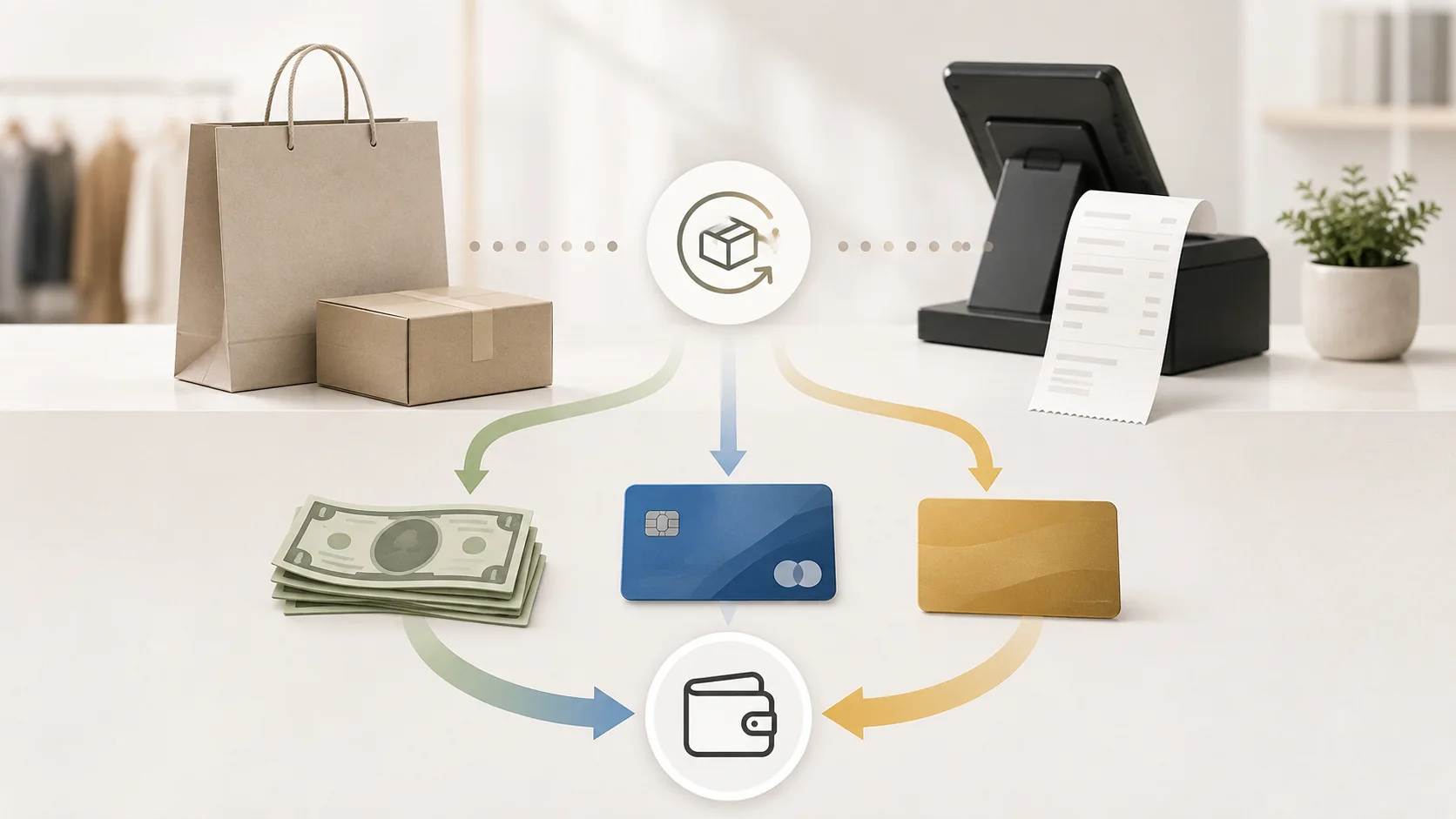
Usually, the refund does not simply go wherever you choose. When you pay for one purchase with both a retailer gift card and a credit card, the store may divide the refund between those payment methods, prioritize one payment method first, or issue some of the refund as a replacement gift card or store credit.
There is no universal retail rule for split-tender refunds. The outcome can also change depending on whether you return the entire purchase or only part of it.
That is why the safest answer is: check the retailer’s refund policy and keep both the receipt and the original gift card until you know you are keeping the purchase.
Why split-payment refunds get complicated
A normal card purchase is simple: you pay $100 on a credit card, return the item, and an eligible refund generally goes back to that card.
A split-tender purchase creates two payment records.
For example:
- $40 paid with a store gift card
- $60 paid with a credit card
- $100 total purchase
If you return the whole $100 purchase, a retailer could restore $40 to gift-card value and $60 to the credit card.
But a partial return creates another question: which payment method absorbs the first dollars refunded?
Retailers do not all answer that question the same way.
Gap gives one of the clearest split-payment examples
Gap’s current refund guidance explicitly addresses purchases made with both a gift card and a credit card.
For a $100 purchase split between the two methods, Gap says a full return can be divided between the credit card and a new gift card.
Its partial-return example is even more useful. If $50 of the original purchase was charged to a credit card and $50 came from a gift card:
- returning a $60 item can result in $50 going back to the credit card and $10 being issued on a new gift card;
- returning a $40 item can result in the entire $40 going back to the credit card.
In other words, Gap does not necessarily prorate every individual returned item across both payment methods. Its published example shows the credit-card portion being refunded first on a partial return.
Gap also says gift-card-funded refunds may go back to the same gift card or be issued on a new gift card.
That is a useful reminder not to assume the original plastic or digital card will always be reloaded.
Best Buy: the gift-card-funded amount stays gift-card value
Best Buy’s current Return & Exchange Policy says that, with limited exceptions, returned purchases are reimbursed in the same way they were paid.
More specifically, if you paid all or part of a purchase with a Best Buy Gift Card, that portion is returned in the form of a new Best Buy Gift Card or e-Gift Card.
So a shopper who paid partly by Best Buy Gift Card and partly by credit card should not expect the entire eligible refund to become a credit-card credit just because a credit card was also used.
The gift-card-funded portion remains store-value rather than being converted into cash-like credit-card value.
Walmart reserves more flexibility on split-payment refunds
Walmart’s published U.S. return policy lists the normal refund method for each type of payment: credit-card purchases can go back to the same card or, in some circumstances, to Walmart gift-card value; Walmart Gift Card purchases are refunded to Walmart Gift Card value.
But Walmart adds an important split-tender clause: when the original purchase used more than one form of payment, Walmart reserves the right, where allowed by law, to issue the refund to only one form of payment.
That is materially different from assuming a refund will always be divided in the exact same proportions as the original transaction.
For a Walmart split-payment purchase, the receipt and the refund screen matter more than a generic formula.
Macy’s can refund original methods first, then use store credit
Macy’s also publishes guidance for returns involving multiple payment methods.
For mail returns, Macy’s says original payment methods are refunded first, while a remaining balance may be issued as store credit. It also notes that purchases made with a gift card can result in store credit.
That means the shopper should not assume a mailed partial return will recreate the original payment split exactly.
The method of return can matter, too. A mail return may be processed differently from an in-store transaction, depending on the retailer’s systems and policy.
Full return vs. partial return
A full return is usually easier to understand because the retailer is unwinding the entire transaction. Even then, the gift-card portion may come back as:
- value restored to the original gift card;
- a replacement gift card;
- an e-gift card; or
- another form of store credit allowed by the retailer’s policy.
A partial return is where shoppers are more likely to be surprised.
Retailers may:
- refund one payment method first;
- allocate the refund across multiple payment methods;
- issue residual value as store credit;
- apply their own internal tender order rather than a simple percentage split.
There is no safe cross-retailer formula such as “credit card first” or “gift card first.”
What if you threw away the gift card?
Do not assume the refund is lost, but do not assume it will automatically move to your credit card either.
Some retailers can issue a replacement gift card. Best Buy, for example, says gift-card-funded return amounts may be issued as a new Gift Card or e-Gift Card.
The practical lesson is simple: keep the original gift card until the return period has passed. Some retailers may restore gift-card value to the original card, while others issue a replacement card.
What shoppers should check before returning
Before starting a return on a split-tender purchase, check five things:
- Your receipt or order detail. Confirm how much was charged to each payment method.
- The retailer’s refund-method policy. Look specifically for gift-card and multiple-payment language.
- Whether you are making a full or partial return. Partial returns can follow a different allocation sequence.
- Whether the gift-card value goes to the original card or a replacement card.
- Whether return channel matters. In-store and mail returns can have different processing rules.
If the policy does not explain split tender clearly, ask customer service one concrete question before surrendering the item: “For this exact order, how much will be refunded to my credit card and how much will be returned as gift-card or store-credit value?”
Bottom line
If you paid with both a gift card and a credit card, the refund may be split—but it does not have to be split the same way at every retailer.
Gap publishes a specific allocation example. Best Buy keeps gift-card-funded value in gift-card form. Walmart reserves the right in some split-payment transactions to refund only one payment method. Macy’s says multiple original payment methods may be refunded first with remaining value issued as store credit.
Treat the retailer’s current policy and your actual receipt as the controlling information.
Sources & Verification
First-party sources checked on 2026-08-28:
- Gap — Refunds & Credits: https://www.gap.com/customerService/info.do?cid=1192368
- Best Buy — Return & Exchange Policy: https://www.bestbuy.com/site/help-topics/return-exchange-policy/pcmcat260800050014.c
- Walmart — Walmart Policies and Guidelines / Return Policy: https://corporate.walmart.com/policies
- Macy’s — What to Expect After I Make a Return: https://www.macys.com/customer-service/articles/what-to-expect-after-i-make-a-return
Last Checked
2026-08-28